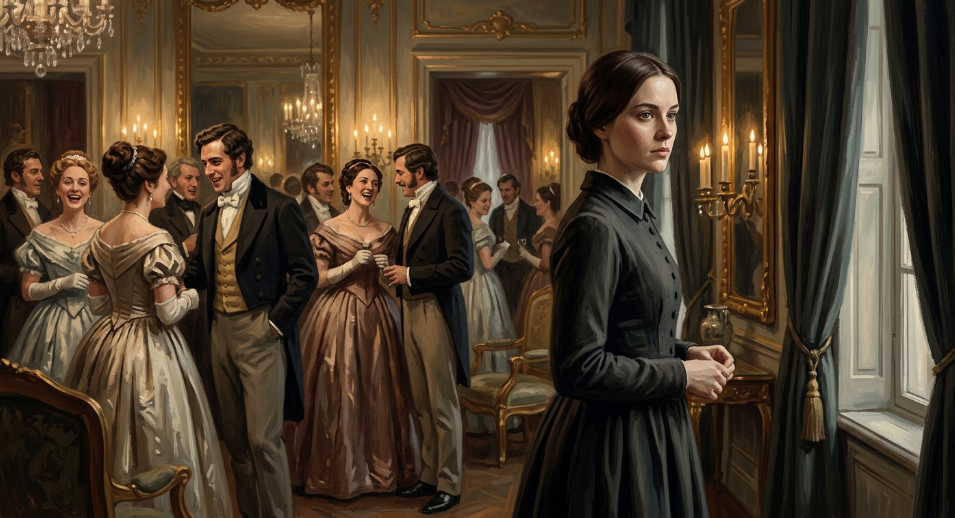
Most female protagonists have beauty slapped onto them like a complimentary suit of narrative armor. It’s incredibly practical. Beauty gets them into interesting situations, makes them important enough for the plot to care about them, and ensures every impressive male character immediately recognizes them as The Chosen One. It’s almost as if conventional attractiveness is a superpower. Every once in a while, this makes me wonder. And every once in a while, it sends me reaching for my keyboard to dissect the whole thing. So here we are.
First of all: yeah, I get it—it feels more enjoyable to read about Scarlett O’Hara’s dazzling green eyes or Anna Karenina’s striking figure than about a fat, sweaty character describing their flushed complexion and hunchback. Fiction is fantasy. We all have our limits.
Then there are the Anastasia Steele and Bella Swan types. Characters so spectacularly under-described that they’re basically human-shaped loading screens. Just enough detail to confirm they’re female and attractive, yet vague enough for you to project yourself onto them while watching their completely ordinary, definitely average beauty reduce every male character within a five-mile radius to a hormonal emergency. What a remarkable coincidence. Unlike some tropes that make me want to throw books across the room, this one isn’t even offensive. It’s just… aggressively uninspired. The literary equivalent of unseasoned mashed potatoes.
And then there are the descriptions that make me wonder whether the author has ever actually seen another human being. You know the “huge violet eyes” type. Right. Every time I read something like that, I think back to the last person I met with naturally violet eyes or with eyes I’d call huge. (Spoiler: I didn’t. Neither did the author.) Unless she accidentally fell into a vat of food coloring, I’m calling bullshit.
To be fair, describing characters is genuinely hard. You want to give readers enough information to picture them, but not so much that you bulldoze their imagination. Take the male lead. Usually we want readers to imagine him as attractive. Unfortunately, I’ve heard rumors that audiences are not, in fact, a perfectly homogeneous hive mind. Apparently there are some—allegedly—who aren’t into towering men with muscles, sculpted cheekbones, and voices deep enough to narrate nature documentaries. Inconsiderate, really. What’s a writer supposed to do with that information?
The answers vary.
Trashy paperbacks, at least, commit to the bit. They don’t dabble in attractiveness—they declare it legally binding. Golden waterfalls of hair. Skin described like it’s been airbrushed by angels on overtime. And the hero arrives looking like he escaped from a Greek statue convention via a testosterone explosion: two meters tall, eight-pack included, jawline sharp enough to qualify as a workplace hazard, eyes brooding as if emotionally contracted for the job. And, of course, an enormous, pulsating… uh… personality. (Yes. Personality. We’re being professional today.) Okay, fine. I’m not into paperback romance, but it’s nice to know there are options.
Or take the “just vague enough for readers to insert their own preferences” strategy. If that works for you, fantastic. Personally, I’d like to know what the main character looks like without having to complete a psychological inkblot test. But that might just be me.
What’s surprisingly rare, though, are characters who are simply… plain. Or unattractive. Which is weird, because the moment you stop treating beauty as the default factory setting, you suddenly unlock a thousand more interesting questions. What does beauty actually do to a person? How does it change the way they’re treated? What happens when they don’t have it? How does it shape confidence, resentment, ambition, desire—all the gloriously messy human stuff?
Few novelists seem genuinely interested in those questions. Charlotte Brontë was.
Her heroines—and heroes—aren’t beautiful because the plot demands eye candy every thirty pages. They’re people first. Their appearance matters because of what it means to them and to everyone around them.
It’s fucking brilliant.
Imagine me doing a tiny, deeply undignified dance of admiration right now.
Because this woman absolutely fucking nailed it. The idea is that beauty functions as unearned social capital, changing the kinds of stories characters get to have. Other characters (mostly men) fawn over beautiful women, lie to them, try to stay close to them, and constantly show them their best side simply because they’re hot. These beautiful heroines rarely have to earn relationships, opportunities, forgiveness, or even respect. Men are already lining up before they’ve said a single interesting thing because they want to get into their pants… uh… marry them.
One of my all-time favorite heroines, Lucy Snowe, can’t rely on turning heads when she enters a room. Instead, she gets plenty of room to develop her intelligence, moral strength, emotional resilience, wit, and powers of observation.
Oh, the powers of observation. Lucy gets to see people’s real faces because they don’t bother putting on an act for her. Her plainness isn’t just an aesthetic detail; it’s a narrative constraint—and, paradoxically, her greatest advantage.
It takes a while to see through Lucy’s eyes and to warm up to her, but once you do… well… it gets pretty intense. She knows about this. There is this amazing short dialogue when Ginevra (a beautiful, shallow, vain party girl) has been enjoying the fête, then seeks Lucy out and drags her into the dressing room to compare their appearances in the mirror. And then she tells Lucy basically the most rude, rude things like how ugly she is, how unimportant socially, and too old (yeah, Ginevra is a real POS). Lucy isn’t even bothered. She pities Ginevra, who is, to use my terminology rather than Lucy’s, dumb as bread.
The conversation goes something like this:
Ginevra: “I would not be you for a kingdom.”
Lucy: “Very good.”
Ginevra: “And what would you give to be ME?”
Lucy: “Not a bad sixpence—strange as it may sound… You are but a poor creature.”
Then Ginevra is astonished and asks how Lucy can think that, given Ginevra’s beauty. Lucy explains that beauty is not what she values. The crucial passage is:
“You would not exchange your position and prospects for mine?”
Lucy responds, in substance, that she would not exchange her own mind, judgment, and self-command for Ginevra’s beauty, because beauty without those qualities is an inferior possession. There is also another layer beneath that, because Lucy implies that Ginevra will never see the world and its people in the same depth as Lucy does, because she simply lacks the equipment (brain- and heart-wise). Lucy isn’t claiming beauty is worthless. She’s claiming that character is a better instrument for perceiving reality than beauty is for navigating it.
That’s something to chew on, right?
Lucy doesn’t even call Ginevra an idiot, but tells her she considers her “clever in her own way” (quite classy, love that for her).
Lucy’s friendships, interactions, observations, and conclusions feel so much more intense. Her affection is earned, never wasted, and because she gives it only to messy, layered people like Monsieur Paul, those relationships feel fully three-dimensional and deeply interesting.
Maybe this already sums it up: Beauty in fiction doesn’t merely attract attention; it also distorts information. Attractive people are constantly presented with edited versions of reality. Lucy, overlooked by almost everyone, receives the unedited version.
Let that marinate for a minute.
PS: Phew… that took longer than expected. I also understand that sometimes you’re simply not in the mood for the psychological excavation that is Lucy Snowe. On a random Wednesday, I too prefer my grumpy Katniss Everdeen. Not because she’s less interesting, but because her universe gives her roughly twelve seconds to process her feelings before launching another life-threatening emergency. Some days you want layered Victorian emotional archaeology. Other days you want Katniss Everdeen solving problems by shooting them.
PPS: Some writers also explore beauty as a premise of demise. If you suddenly feel the need to bawl your eyes out over this particular brand of tragedy, I recommend The Lady of the Camellias (never approach that fucking book without a handkerchief. Trust me.).